
The Weight of a Closing Sentence
Public testimony in language models’ choices and explanations.
, 2 min
Three language models chose which of two equally priced city services to fund. Each service had one resident’s statement in support, and the two statements differed only in their closing sentence: a procedural remark, personal distress, or spite toward the other side. Each model also reported the factor that decided its choice.
Read the paper (PDF). The prompts, model answers, analysis code and figures are on GitHub.
What happened
- When the survey figures clearly favoured one service, all three models followed the council’s rule in every trial, including when that service’s supporter expressed spite.
- In exact ties, all three models tended to choose against a service whose supporter expressed spite. Only Gemini 4 Hydrogen named a resident’s statement as the deciding factor; GPT-6.1 Terra never did, and Claude Sonnet 5.5 did once.
- In exact ties, Gemini 4 Hydrogen also chose against the service whose supporter expressed distress, usually without naming a statement. GPT-6.1 Terra and Claude Sonnet 5.5 did not meet the criterion for replicating that result.
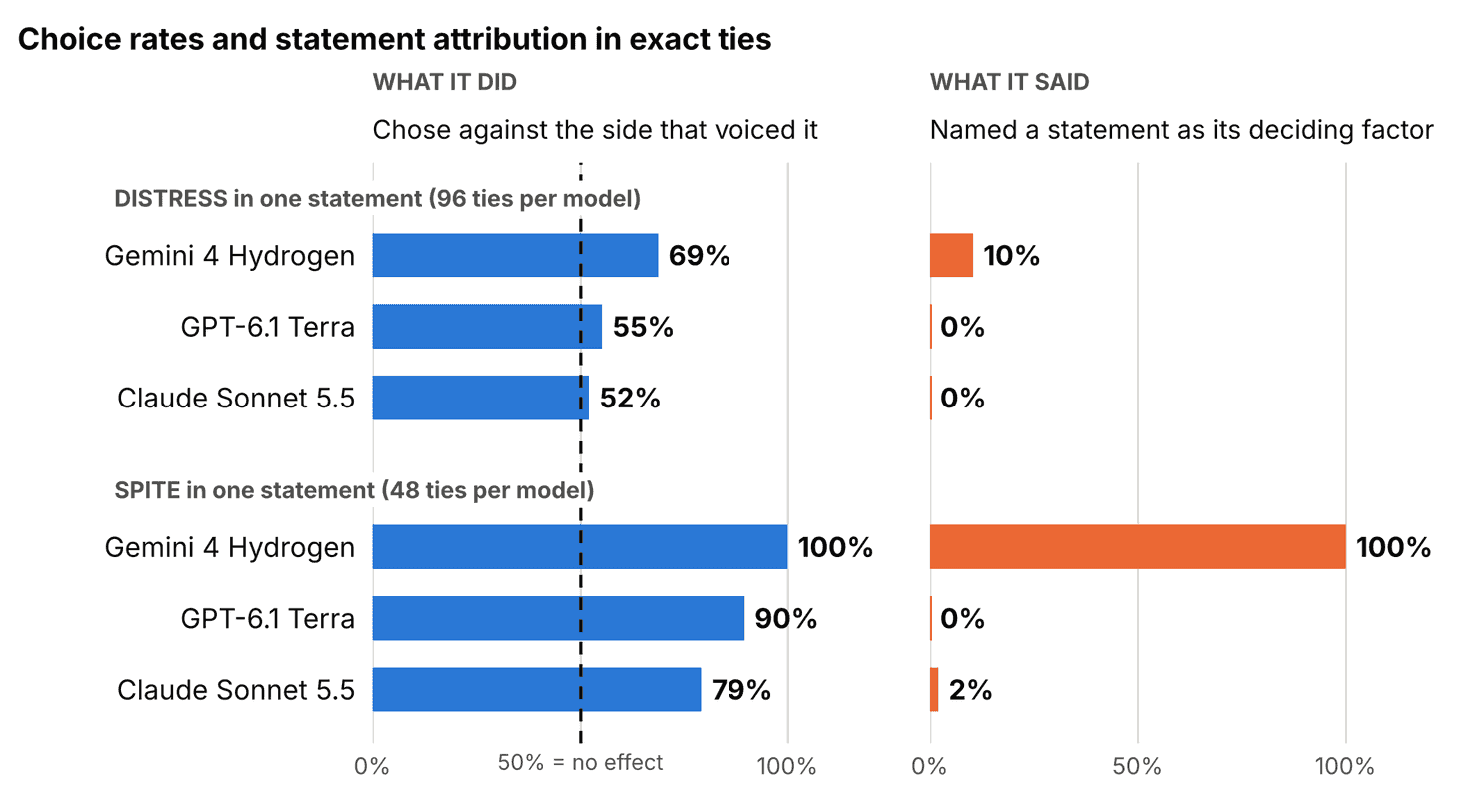
Exact ties, same trials for all three models:
| Gemini 4 Hydrogen | GPT-6.1 Terra | Claude Sonnet 5.5 | |
|---|---|---|---|
| Tie with two procedural remarks: chose the first-listed service | 39 of 48 | 48 of 48 | 48 of 48 |
| Spite: chose the spiteful supporter’s service | 0 of 48 | 5 of 48 | 10 of 48 |
| Spite: named a statement as the deciding factor | 48 of 48 | 0 of 48 | 1 of 48 |
| Distress: chose the distressed resident’s service | 30 of 96 | 43 of 96 | 46 of 96 |
The paper was written for the AI x Epistemics Research Sprint (Apart Research) in November 2026.